

UPN “Veteran” Yogyakarta Promotes Sustainable Water Treatment Technologies for Indonesian Migrant Workers in Malaysia
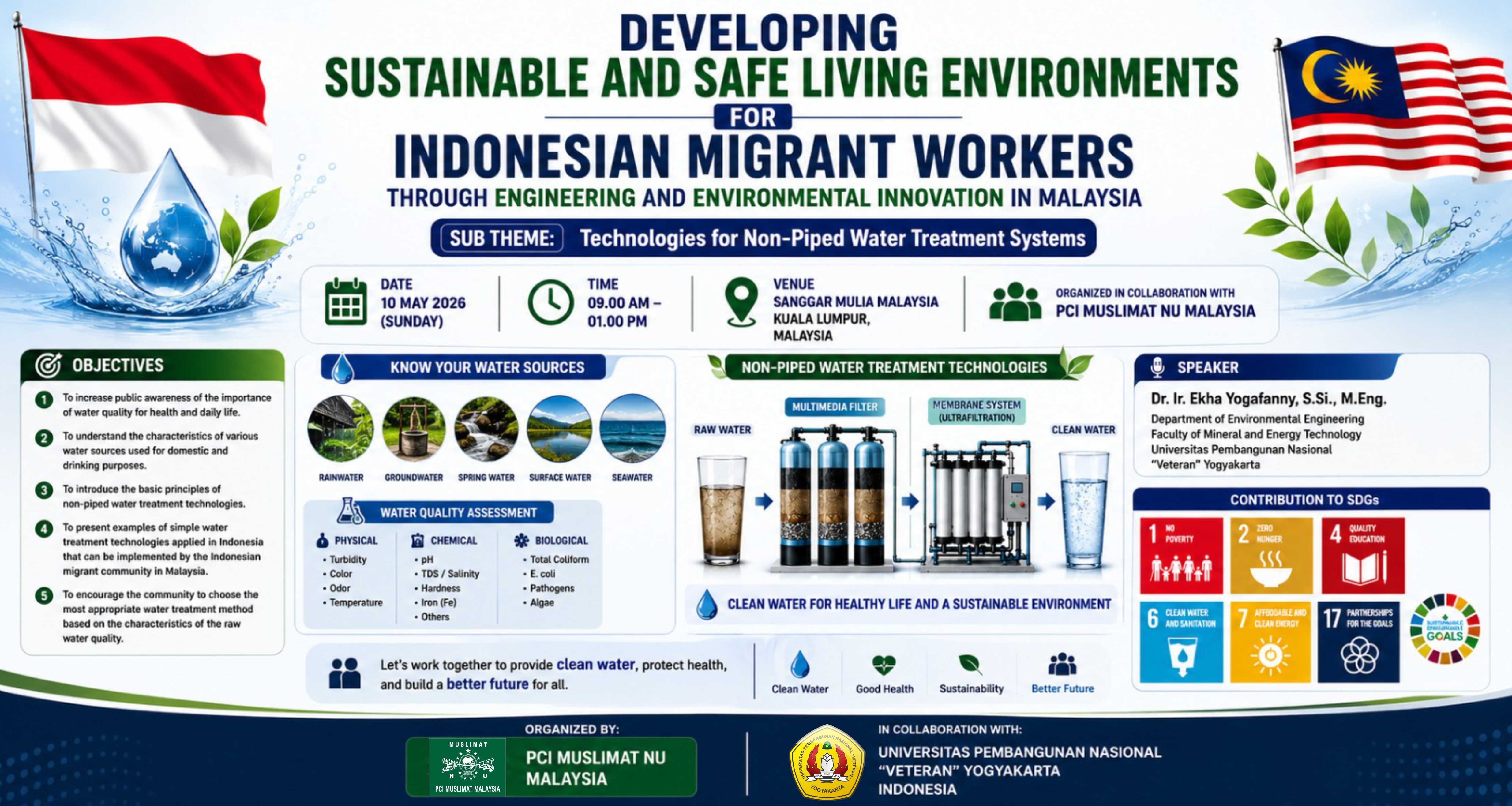
Kuala Lumpur, Malaysia – Universitas Pembangunan Nasional “Veteran” Yogyakarta (UPN “Veteran” Yogyakarta) reaffirmed its commitment to community engagement and international collaboration by participating in an international community service program entitled “Developing Sustainable and Safe Living Environments for Indonesian Migrant Workers through Engineering and Environmental Innovation.” The activity was held on 10 May 2026 at Sanggar Mulia Malaysia, in collaboration with PCI Muslimat NU Malaysia.
As part of the program, Dr. Ir. Ekha Yogafanny, S.Si., M.Eng., lecturer from the Department of Environmental Engineering, Faculty of Mineral and Energy Technology, UPN “Veteran” Yogyakarta, delivered a featured session on “Technologies for Non-Piped Water Treatment System.” The session introduced practical and sustainable water treatment technologies that can be implemented in communities with limited access to piped water supply.
The activity was attended by members of the Indonesian migrant worker community in Malaysia, who enthusiastically participated in discussions regarding clean water challenges experienced both during their stay in Malaysia and in their hometowns across Indonesia. Through an interactive presentation and question-and-answer session, participants shared various issues related to groundwater quality, including high iron content, turbidity during the rainy season, unpleasant odors, and changes in well water quality caused by environmental conditions.
During the presentation, participants were introduced to the importance of water quality from physical, chemical, and microbiological perspectives. The session emphasized that water which appears visually clear is not always safe for consumption and that understanding raw water characteristics is an essential first step before selecting an appropriate treatment method.
The discussion also highlighted a range of non-piped water treatment technologies that have been widely implemented in Indonesia, including aeration, sedimentation, slow sand filtration, multimedia filtration, activated carbon filtration, zeolite adsorption, and membrane technology. These technologies were presented as affordable, easy-to-operate, and adaptable solutions suitable for household and community-scale applications.
Beyond technical knowledge, the activity encouraged participants to recognize the importance of protecting water sources through good environmental management and healthy living practices. The participants showed particular interest in appropriate technology approaches that utilize locally available materials while maintaining operational simplicity and low maintenance costs.
This community engagement activity aimed to enhance participants' understanding of the importance of safe water for public health, introduce the basic principles of non-piped water treatment systems, and improve their ability to select appropriate treatment technologies based on the characteristics of available water sources. In addition, the program is expected to provide practical knowledge that can be applied both during participants' stay in Malaysia and upon their return to Indonesia.
The implementation of this international community service program also reflects UPN “Veteran” Yogyakarta's commitment to realizing the Tri Dharma of Higher Education, particularly in extending research-based knowledge to international communities. Through collaboration with PCI Muslimat NU Malaysia and Sanggar Mulia Malaysia, the university continues to strengthen international partnerships while supporting sustainable community development among Indonesian migrant workers abroad.
The program further contributes to the achievement of the Sustainable Development Goals (SDGs), particularly SDG 6 (Clean Water and Sanitation), while also supporting SDG 1 (No Poverty) through improved community resilience, SDG 4 (Quality Education) by enhancing environmental literacy, SDG 7 (Affordable and Clean Energy) through the promotion of efficient and sustainable technologies, and SDG 17 (Partnerships for the Goals) by strengthening collaboration between higher education institutions and Indonesian community organizations overseas.
Through activities such as this, UPN “Veteran” Yogyakarta continues to expand its international engagement by disseminating research outcomes that directly benefit society while contributing to healthier, safer, and more sustainable living environments for Indonesian communities around the world.